
START-UP
Welcome to Avorkarth, a realm of low-fantasy adventure. This rulebook will aid players in setting up a role-playing session ( known as a campaign or adventure) based within the realm of Avorkarth and will give an understanding of the many ways the players may manipulate or interact with the world they find themselves in.
Long time table-top players may find that this game is not quite as mechanically balanced as similar table-top games out there, with the idea instead of being more immersive.
Each section of the rulebook will tend to a specific set of rules that defines what actions or choices the player's character may take. If this is the first time that a player will enter into the realm of Avorkarth, it is highly recommended that they read the rulebook even if they've previously played other similar table-top role-playing games.
Base Requirements
Players (Recommended: 3 to 7)
The players of Avorkarth are separated into two categories.
Game Master/Dungeon Master (GM/DM): A single player takes the role of arbitrator for the current and future sessions, known as the Game Master. Their role is to control all non-player characters, creatures and challenges and are also in charge of creating and/or setting the stage for the adventure that the remaining players will go through.
Adventurers: The remaining players each control a single character, usually of their own creation, and are tasked with finishing the goal given by the Game Master with the skills and abilities of their controlled character. Keep in mind that Avorkarth is meant to be immersive and therefore open to be won in many ways and with different groups of characters, not always with characters famed in bloodshed and swordplay.
Required Tools
Avorkarth is based upon traditional paper and pencil role-playing games, and as such may be fully played as long as players have access to six-sided dice and a method of jotting down information such as a pad of paper. With the advancement of technology, there are many dice-rolling programs/apps and tablets are fantastic to record information.
Area of Play
While playing around a table with friends is an incredible experience, it is also entirely possbile to play with others from around the world using online voice-chat systems. There are even many websites and digital programs dedicated to recreating table-top like experiences.
6 Sided Dice
Avorkarth uses 6 sided dice as its main playing component, with rolling dice representing the randomality of life for most characters actions. Should a character wish to jump, charm, sooth, tend, attack or do any other action in which the result is not wholly predictable, they would roll the required amount of dice and compare the results with the dice-rolling charts to know if they've succeeded.
Adventurers - Character Sheets
Players who take on the role of adventurer need to create and take control of a single character, an avatar of their own will within the realm. These characters do not necessarily represent the player themselves, but rather are a character of their own. They can have their own personality, set of skills, strengths or weaknesses of completely unrelated note to their player. Most information for the character creation process, other than the rules, is found in the World Lore section and book.
DICE ROLLS
Dice rolls are one of the most important part of the whole game, used for almost all interactions. Whenever a character or creature wishes to interact with the world and there is a chance of failure, they must roll one or more dice. This die roll is the equivalent of the attempt as well as the result of the action, be it good... or bad.
Rolling
Roll Value
The value of a roll is dependant on the character's relevant skill or attribute value. Unlike many other table-top role-playing games, the characters bonuses and values are not added to the dice results. Instead, the value is used as a check against the opposite value of the action the character is attempting, known as a Difficulty Check.
Minimum Values
Any roll value (after any calculations) that is below 1 is always considered as a value of 1. (So should a caculation lead to a roll value of -2, it is counted as 1).
Difficulty Check
The difficulty check is the opposing value that the roll value is compared to. Every action has a counter, be it a characters ability to resist a charm or to dodge an incoming attack. Difficulty checks are often called "DC"s for short.
Determining Outcomes
To see if a character's action was successful after rolling the dice, they compare their roll value against the difficulty check in the table here below. The greater the difference between the roll value and the Difficulty Check, the more the die's result leans towards a particular outcome.
Roll Example
A skillful thief is attempting to stealthily hide from the nearby patrolling guard.
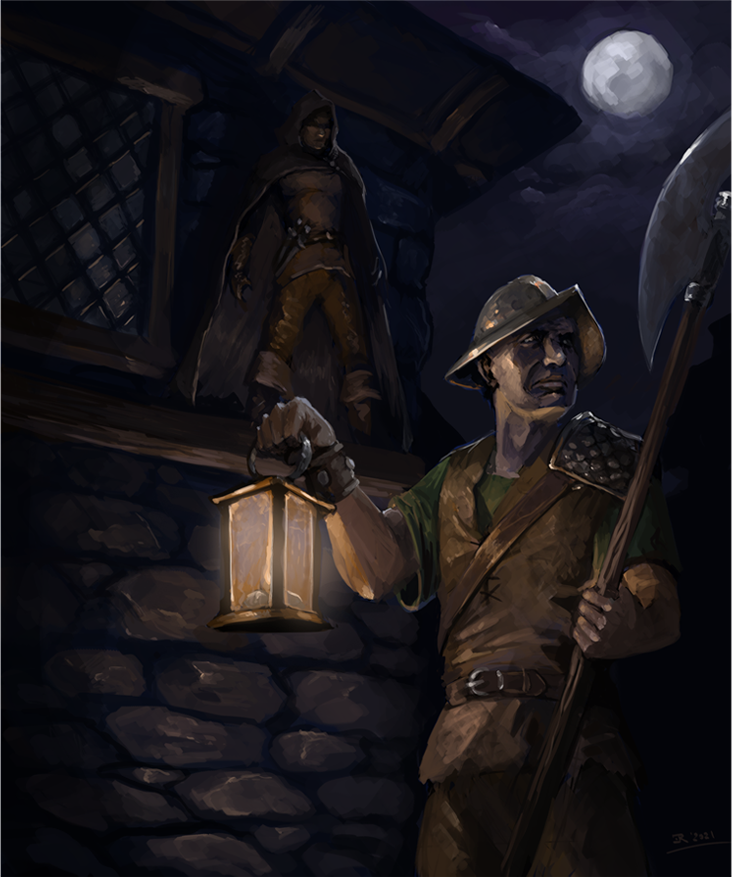
"Lanterns do not aid the burden of inattentive eyes." - Thief's saying
| Critical Fail | Fail | Partial Success | Success | Critical Success | |
|---|---|---|---|---|---|
| Roller is 10+ Greater | - | - | - | 1-2 | 3+ |
| Roller is 7+ Greater | - | - | 1 | 2-3 | 4+ |
| Roller is 5+ Greater | - | - | 1-2 | 3 | 4+ |
| Roller is 3+ Greater | - | 1 | 2 | 3-4 | 5+ |
| Roller is 2+ Greater | - | 1 | 2-3 | 4 | 5+ |
| Roller is 1+ Greater | - | 1-2 | 3 | 4-5 | 6 |
| Roller is Equal | 1 | 2 | 3-4 | 5 | 6 |
| DC is 1+ Greater | 1 | 2-3 | 4 | 5-6 | - |
| DC is 2+ Greater | 1-2 | 3 | 4-5 | 6 | - |
| DC is 3+ Greater | 1-2 | 3-4 | 5 | 6 | - |
| DC is 5+ Greater | 1-3 | 4 | 5-6 | - | - |
| DC is 7+ Greater | 1-3 | 4-5 | 6 | - | - |
| DC is 10+ Greater | 1-4 | 5-6 | - | - | - |